
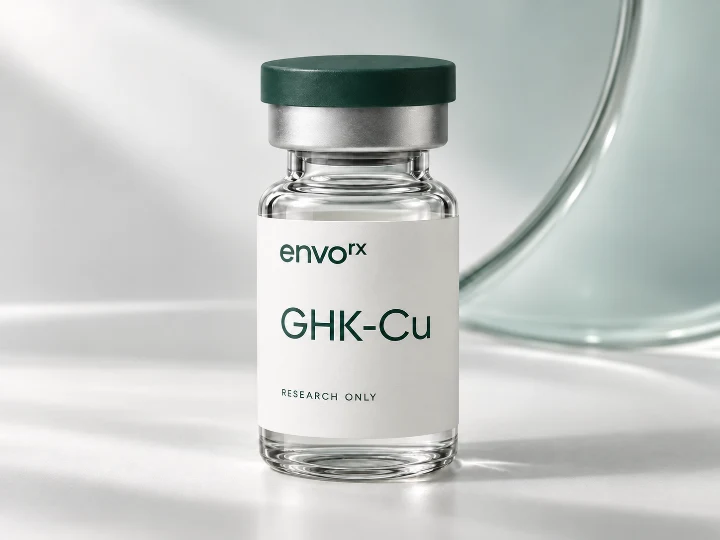
Start with the identity.
GHK names the amino-acid sequence glycine–histidine–lysine. GHK-Cu is its complex with copper. A molecular name is useful for finding papers, but it does not identify every formulation, batch or finished product bearing that name. When comparing an online listing with a study, check the exact material, experimental conditions and outcome. Our GHK-Cu listing provides a place to review the catalog presentation; it should not be treated as the material tested in a paper simply because the names overlap.
The 1988 work examined cultured cells.
Maquart and colleagues reported increased collagen synthesis in fibroblast cultures exposed to GHK-Cu. Fibroblasts are cells involved in connective-tissue biology. The study measured a biological response in a controlled laboratory system, rather than a cosmetic outcome or a clinical result in people. The authors reported that the change in collagen synthesis was independent of a change in cell number. Those details matter: the measured outcome is more specific than a broad claim about how a person might look or feel.
The 1993 work used a rat wound model.
A later paper investigated GHK-Cu in experimental wound chambers in rats. Researchers analyzed components including collagen, proteins and glycosaminoglycans and reported increased connective-tissue accumulation within that model. This adds whole-organism experimental context, but the species, wound model, conditions and measured outcomes remain essential limitations. It was not a human clinical trial. It did not test an Envorx product, establish equivalence between commercial preparations, or determine an appropriate personal-use regimen.
Ask a narrower question before drawing a conclusion.
A useful reading checklist is: what was tested, in which model, against which comparison, and what changed? Then ask what the experiment did not measure. Cell and animal studies can help investigate mechanisms; they do not by themselves establish clinical effectiveness or safety in people. A published result also does not certify the identity, purity, sterility or intended use of a vial sold elsewhere. Those are separate questions requiring the actual product label and batch-specific documentation.
Keep the original source close.
This is a focused walkthrough of two early studies, not a systematic review of all GHK-Cu literature. Read the original abstracts and methods, notice the experimental model, and distinguish the authors’ observations from later marketing interpretations. No personal-use instruction, preparation procedure or dosing recommendation follows from this article. If your question concerns your own health, discuss it with a qualified clinician rather than treating a research catalog as a source of medical care.
Original sources
These papers explain the research examples used in this article. They do not certify a commercial product or provide a personal-use recommendation.
- Maquart et al. · Collagen synthesis in fibroblast cultures · 1988Cell culture, not a clinical trial
- Maquart et al. · Connective-tissue accumulation in rat experimental wounds · 1993Rat wound model, not a clinical trial